
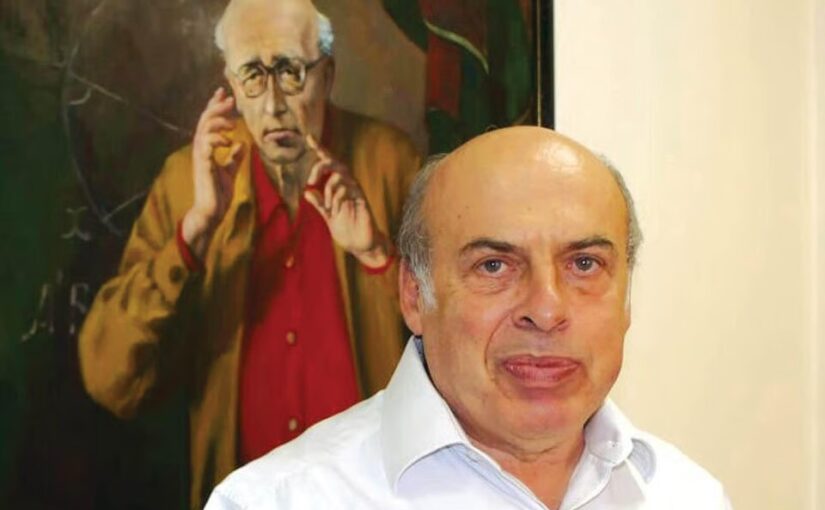
“Many portraits of Israeli prime ministers have decorated the walls of my office,” says prominent Israeli politician and activist Natan Sharansky. “But there is one constant: a portrait of Andrei Sakharov is always there.”
The striking portrait of Dr Andrei Sakharov — the sitter wearing a red shirt, a colour somehow at odds with the scientist’s famously modest demeanour — was painted in 1998, nearly a decade after Sakharov’s untimely death. Vyacheslav Tsai, a painter based in Nizhny Novgorod, the city to which Sakharov and his wife had been exiled in the 1980s, drew on photographs from that period to create his tribute to the Soviet dissident, a man with deep ties to the region.
In 1999, a trade delegation from Nizhny Novgorod visited Sharansky — then serving as Israel’s minister of trade and industry — and presented him with the portrait. His admiration for Sakharov was no secret.
Sharansky, trained as a physicist, became one of the leading voices in the Soviet Jewry movement’s campaign for the right to Aliyah. In that struggle, he grew close to Sakharov and his family, eventually serving as Sakharov’s press secretary. That bond endures to this day.
The Jackson-Vanik Amendment, signed into law in January 1975, enshrined the right to free emigration — but Soviet authorities were determined to apply it on their own terms. Sharansky’s desire to repatriate to Israel earned him the label of traitor and a threat of capital punishment. In 1977, he was sentenced to thirteen years in a penal colony.
It was the unwavering determination of his wife, Avital, that helped bring him home: in 1986, after nine years, Sharansky was released in a dramatic prisoner exchange on the Bridge of Spies (formally, Glienicke Bridge) in Berlin. With tears in his eyes after nearly a decade apart, he greeted Avital with a quip: “Sorry, dear, I got a bit delayed.”