
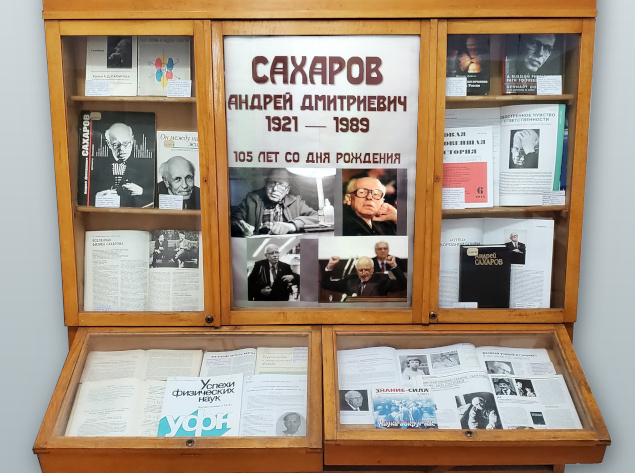
On the 105th anniversary of Andrei Sakharov’s birth, his legacy was quietly marked across Russia. Book exhibitions dedicated to his life opened in Moscow’s Natural Sciences Library and in regional libraries in Ryazan, Irkutsk, Kursk, Toropets, Saratov, and Vladivostok — covering not only his scientific achievements but also his dissident activity and social thought. Articles appeared in Lenta.ru, Gazeta.ru, and Komsomolskaya Pravda; an exhibition at the Rosatom pavilion at VDNKh — the great Soviet-era Exhibition of Achievements of the National Economy in Moscow — featured a narrated video on his life and work.
These are modest gestures. They must be read against a backdrop that Sakharov himself would have recognised with sorrow. In the fifth year of its full-scale war against Ukraine, the Kremlin has continued to escalate its crackdown on Russian civil society, targeting critics both inside the country and in exile. In 2025 alone, the Justice Ministry designated 215 individuals and organisations as “foreign agents,” including news outlets, journalists, artists, and civil society activists. The space for the kind of open, pluralist society Sakharov spent his life advocating has rarely been narrower.
And yet the anniversary was marked. Sakharov’s name was spoken, in public, in institutions funded by the Russian state. That is not nothing.
It points to something that sets Sakharov apart from almost any other figure of the Cold War era: he is one of the exceedingly rare individuals viewed with genuine respect on both sides of what has become, once again, a deep civilisational divide. In the West he is remembered as a dissident and Nobel Peace laureate, a conscience who spoke truth to Soviet power. In Russia he remains the father of the hydrogen bomb — a patriot, a man of the state, a titan of Soviet science — whose later convictions many may quietly admire even where they cannot say so aloud. This dual identity is not a contradiction. It is precisely what makes him a potential point of reference when the time comes, as it eventually must, to think about rebuilding.
That time is not now. The most plausible near-term scenarios for the conflict in Ukraine range from prolonged low-intensity confrontation to a ceasefire, with a genuine and lasting peace agreement remaining the hardest outcome to achieve. Even a ceasefire, should one materialise, would leave unresolved the deeper questions: about sovereignty, about accountability, about what kind of Russia might eventually emerge from this period. Political renewal inside Russia itself — the precondition for any durable rapprochement — remains, for now, a distant prospect rather than an imminent one.
But distant is not the same as impossible. History moves in ways that confound prediction. The Soviet system, which once seemed immovable, did not outlast Sakharov by long. What endures from his example is the insistence that the work of reason and conscience must continue even when the odds appear overwhelming — that détente and rapprochement are not merely diplomatic transactions but expressions of a deeper willingness, as he put it in his Nobel lecture, to build a better world. In that lecture, Sakharov called on humanity not to minimise its sacred endeavours, concluding: “We must make good the demands of reason and create a life worthy of ourselves and of the goals we only dimly perceive.”
Those words were addressed to a world living under the shadow of nuclear arsenals, divided by ideology, and seemingly locked into permanent confrontation. They were not written for easier times. They were written for times like these.