
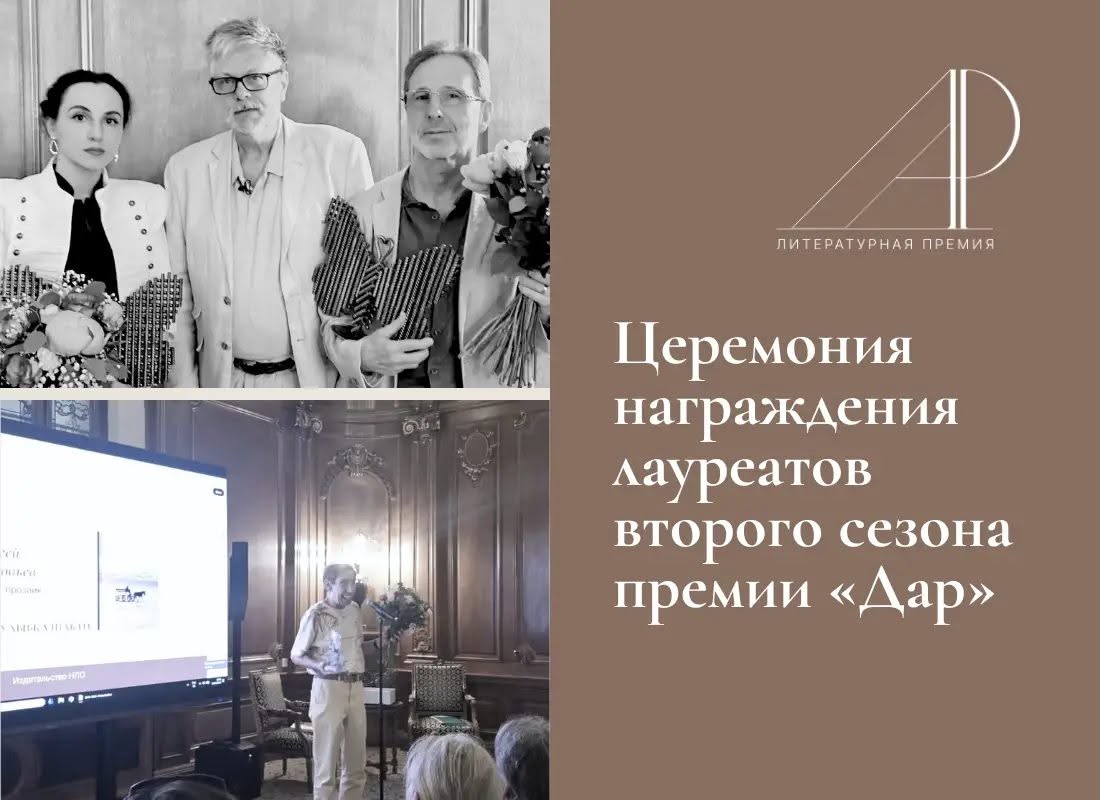
The second season of the Dar Prize
On June 19, 2026, the award ceremony for the winners of the second season of the Dar Prize took place in Montreux, Switzerland. The prize is a grant for translation into three languages: English, German, and French. The Award’s mission is to promote Russian-language literature, uniting all who read and write in Russian regardless of their place of residence, and to foster a Russian culture free from politics.
This year, three books from the shortlist received an equal number of jury votes: “A Little Paradise” by Ksenia Buksha, “Lullaby for Mariupol” by Alexandra Krashevskaya, and “Days of Repentance” by Oleg Radzinsky. Unsurprisingly, all three books deal with the war in one way or another.
Present at the ceremony were the winners Alexandra Krashevskaya (“Lullaby for Mariupol”), Oleg Radzinsky (“Days of Repentance”), and the winner of the readers’ vote from the first season, Sergei Solovyov (“Shakti’s Smile”). They were presented with special prizes created by sculptors Konstantin Benkovich and Igor Frolov. The third winner, Ksenia Buksha (“A Little Paradise”), was unable to attend and will be presented with her award at the ceremony for the winners of the third season.
Alexandra Krashevskaya’s “Lullaby for Mariupol” has become one of the most powerful testimonies of war in recent years. The subtitle, Thirty Dreams Without Waking, gives the book its structure: thirty dream-chapters, from the first explosions in February to the evacuation in May 2022. But these are not dreams in any ordinary sense — they are the state of dissociation into which a person sinks when reality becomes unbearable. “You suddenly and distinctly fall into a deep, hopeless sleep. One from which there is no waking.”
In Oleg Radzinsky’s “Days of Repentance”, a Moscow family desperately tries to follow the regime’s doctrine of keeping politics at arm’s length, only to be confronted with the catastrophic realities brought by the full-scale invasion of Ukraine. Their world is shattered — yet true atonement remains elusive, mirroring the moral paralysis of contemporary Russian society. Spiritual healing, the novel suggests, remains a fading dream.
The Dar Prize continues to grow in both reach and resonance. This year, the award was supported by a number of organisations committed to the survival of free Russian culture, among them the Andrei Sakharov Foundation. As the third season gets underway, the prize stands as a reminder that literature — even, and perhaps especially, in the darkest of times — remains one of the most honest witnesses we have.