
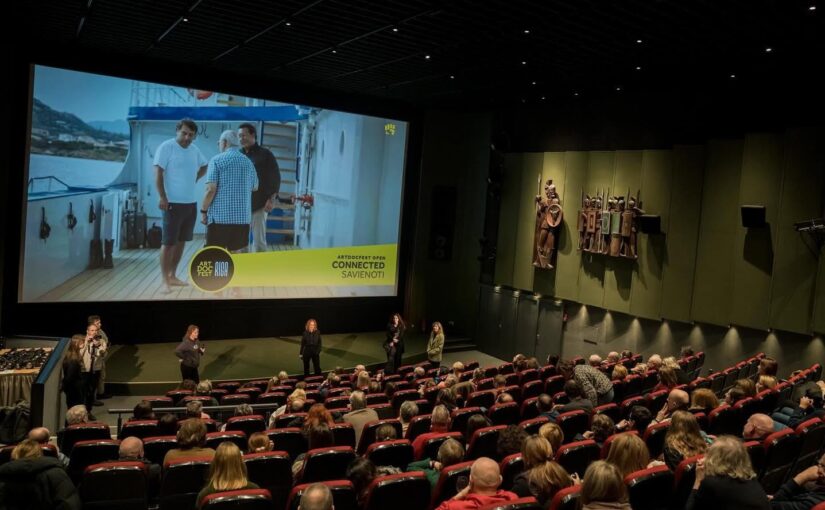
WHEN THE AMERICAN DREAM MEETS THE RUSSIAN DESTINY
“CONNECTED”, a new documentary by an award-winning London-based director Vera Krichevskaya, premiers at Riga’s ArtDocFest to a wide critical acclaim and emotional public reception.
The film tells a story of Dmitry Zimin. A radio engineer by training, Zimin transformed himself into an incredibly successful businessman in the course of the Gorbachev’s Perestroika. Zimin and Augie Fabela, his American partner founded VimpelCom, one of the leading mobile operators in Russia. Their business success enabled Zimin to become one of the most prominent philanthropists in Russia.
In the period from 2001 to 2015, Zimin’s philanthropy project, a foundation called “Dynasty” spent over 2.5 billion rubles on numerous science and education projects in Russia. In February 2015, Dmitry Zimin’s philanthropic work was recognised with a prestigious award from the Russian Ministry of Science and Education. Ironically, three months later, in May 2015, the Russian Ministry of Justice labelled “Dynasty” a foreign agent. The reason for the authorities’ ire was Zimin’s support of the Russian opposition. Disgusted, Zimin closed down “Dynasty” and left Russia with his family.
The film is about death. Eighty-eight years old, frail and cancer-stricken Zimin bids farewells to his family and friends aboard of a boat and shares his conviction that dying is a necessary feature of life, a sign of renewal. One of his friends quotes Hemingway to explain Zimin’s fortitude: “But man is not made for defeat. A man can be destroyed but not defeated.” “Bury me in my ski boots and write on my grave “this subscriber is out of the network coverage,”” suggests Dmitry Zimin to his family.
Leaving this world on December 21, 2021, Zimin predicted the start of Putin’s war in two months. Alexey Navalny, whom Zimin had long supported, was by then in prison, later to be killed. Overcome with raw emotions, viewers may feel longing for another Russia, Russia where her true heroes are feted and not destroyed.
The trailer of the documentary below
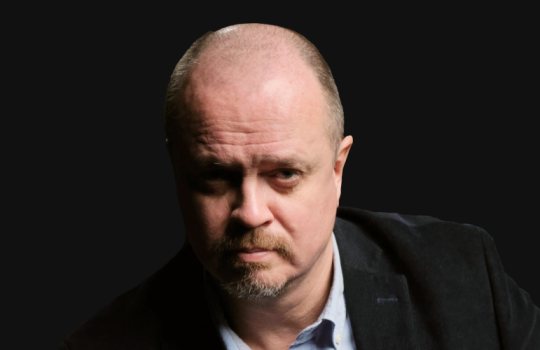
Ivan Pavlov: When the laws do not work, legal assistance is palliative. But the importance of palliatives should not be underestimated
Founded in December 2021 by Ivan Pavlov, a prominent lawyer, First Department is a human rights project with a special focus on closed court hearings and the use of criminal cases against political opposition in Russia. His previous legal project was labelled “undesirable”. To avoid criminal charges himself, Pavlov and his team left Russia.
The war in Ukraine led to the significant growth of a specific category of political repression, namely, charges with state treason. The ASF talked with Ivan Pavlov about the use of “state treason” charges.
– How many people are charged with treason yearly in Russia? For example, in the USA, there have been about 40 cases of people standing accused of treason throughout the history.
Such an article is in the legislation of almost every country, it’s just that often there is no practical application. As for Russia, until 2014, before the start of direct confrontation with the West, there were about 2-3 sentences a year, in 2015 there was an outbreak of 15 sentences. Every year, before the start of a full-scale war, about 15 sentences were passed for high treason. In 2022 there were 16 of them, in 2023, the total grew to 39. Sometimes about two years can pass between the initiation of a case and the delivery of a verdict. In 2023, it is known that about a hundred cases have been filed, and now, I am sure, there will be even more. This is a sign of war, there is a demand for internal enemies. The FSB intelligence service is authorized to search for and develop them.
– At the beginning of the war, there were assumptions that the FSB was accustomed to considering treason cases individually, that they did not have the resources to initiate such cases en masse. How did they do this?
I wouldn’t say it’s massive. 100 cases for 140 million Russians is not a massive number. These are not thousands of cases. There cannot be too many such cases. Otherwise, the cost for private investigations of treason will be devalued. This is specialisation of the elite first department of the investigative department and elite FSB operatives. Now they have begun to invite regional departments to develop it. But still, there are not so many cases yet: there is no demand for thousands of cases of treason. There shouldn’t be too many internal enemies – that’s a political component. There are enemies, but they are isolated, they need to be shown. The authorities are looking for balance.
– Previously, the target group was scientists, but now wider layers are under attack?
Scientists were one of the categories. Previously, treason cases were initiated against as diverse members of the Russian society as bloggers, housewives, top managers of large companies, military personnel, clergy, and farmers markets tradespeople. In 2022, amendments were made to the definition of the law. Switching to the enemy’s side has been added as an additional form of treason. They identify young people who have careless correspondence with Ukrainian organizations, they are charged with assassination attempt or preparation to go to the enemy’s side, and they are also charged with Article 275 of the Criminal Code. There are a lot of cases for providing assistance to a foreign organization in conducting activities directed against the security of Russia. Donations to Ukrainian foundations are considered treason in the form of financial assistance.
– A young man, Nikita Zhuravel, was sent to jail for publicly burning the Koran. Then a video was circulated of Nikita being beaten by Adam Kadyrov, the son of the head of Chechnya, in the interrogation room. Then new accusations appeared against Zhuravel: that he not only burned the Koran, but also photographed something for the Ukrainians?
Yes, and he got 14 years in prison for treason.
– The case of 66-year-old physicist Anatoly Gubanov and other scientists. Why are elderly scientists often charged with treason in Russia? Because there are generally a lot of older people in Russian science?
An elderly scientist is an easy prey for a security officer. It’s convenient to take it and shake it, the old one. He will completely agree. These are people of the Soviet type: they trust the system, they resist little. They are charged mainly with actions that took place during the Medvedev warming period, when many scientific institutions collaborated with foreign institutions. International projects were approved by all necessary government authorities.
Accordingly, information was exchanged with foreign organizations. It was normal when, but then it became overrated. In order to impute treason, it is necessary to find the one who sent secret information to foreigners. They take an international project and look: somebody was authorized to correspond with foreign partners. They check his email. They find some of his reports. They give reports to experts who are ready to see state secrets in anything. This is how the scientist becomes the accused.
– Often, criminal cases of treason, when they are paid attention to in the media, look very strange. The accusations are quite ridiculous. Doesn’t the FSB care?
They hate when you call them idiots, but they fulfill a political demand. They receive promotions in ranks, awards, and medals. These cases are their career ladder.
– Have you come across stories where the accusation of treason was actually applied to people who stole some secrets for foreign intelligence?
In my large practice in these matters, I have not met any real spies.
– “Meduza” published the story of a real person, a former National Bolshevik, who, for ideological reasons, got a job in police in order to transmit information to American intelligence, is now imprisoned for treason.
Real spies probably exist: just how to catch them. Especially if all the forces of the secret service officers are spent on developing fictitious spies.
– There was only one case of acquittal regarding treason, the Pasko case many years ago?
In 1999, Alexander Nikitin was acquitted by the St. Petersburg City Court. Grigory Pasko, in a completely symmetrical case, was already convicted in 2001: he was sentenced to only four years in prison. The article provides a punishment from 12 to 20 years. A year later, Pasko was released.
– How much is the average price now for treason?
Fifteen years in prison.
– Journalist Ivan Safronov sentenced to 22 years because he had episodes added up?
Yes. Fifteen is given per episode.
– In the current conditions, when someone accused of treason begins to defend himself, what can he achieve? What is a good result?
As you correctly noted, the last acquittal was in the previous century. Now, at best, you can count on a minimum term, and it is better not to go through legal procedures at all. Sometimes people can be taken away from Russia before they come for them.
– And if FSB has already arrived, how can you help?
Transfers to pre-trial detention centers. And letters. Now, when the laws do not work, legal assistance is palliative. But the importance of palliatives should not be underestimated. A lawyer, a person nearby who supports you – this is also important. Informationally, at least. You will know what is going on. A competent person who records all violations. These cases will be reviewed later. It is important that in criminal cases of treason, a competent lawyer records violations and leaves traces in the case materials. But in wartime, fair trials in politically motivated cases cannot be counted on.
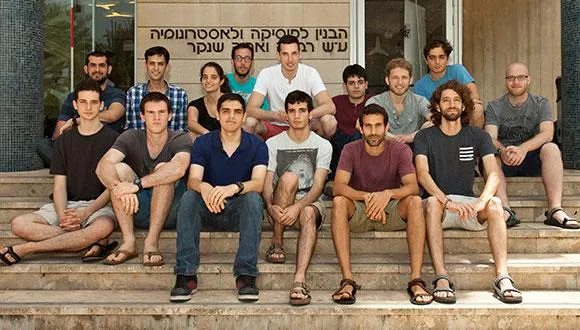
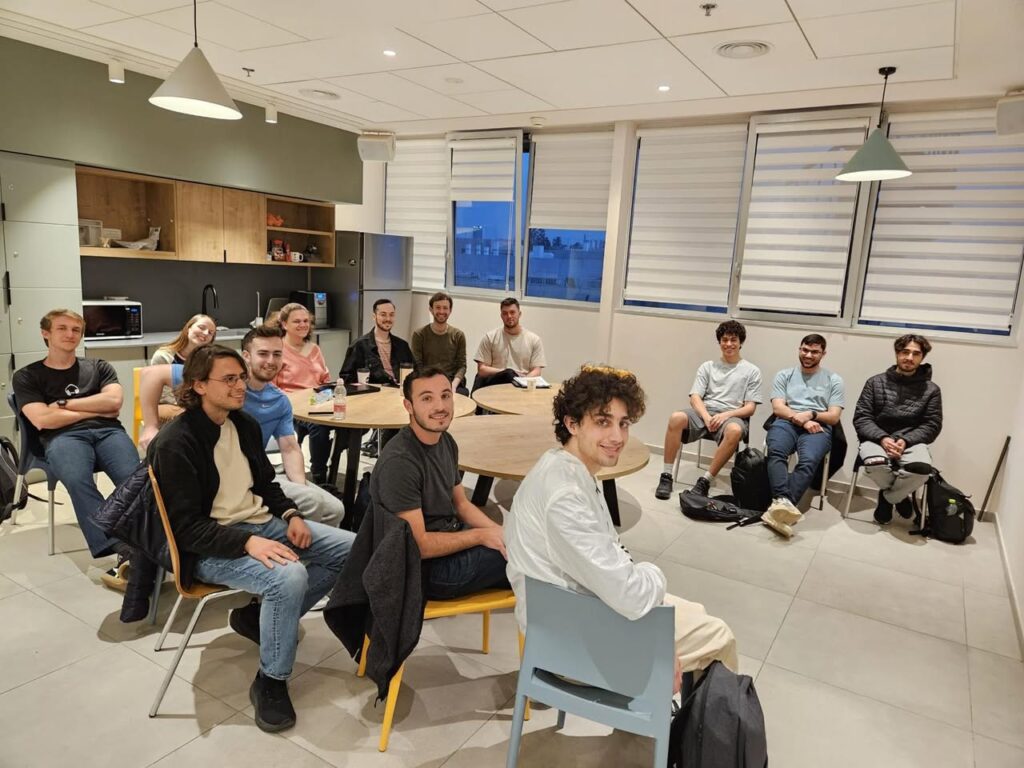
The Andrei Sakharov Excellence in Physics at Tel Aviv University
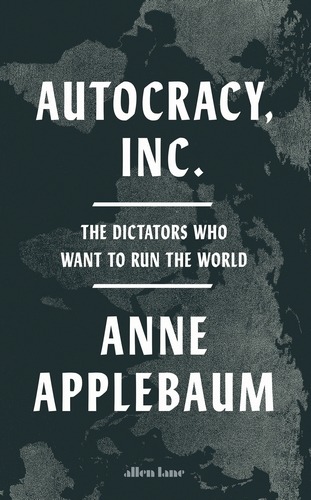
Autocracy, Inc.: The Dictators Who Want to Run the World by Anne Applebaum
Anne Applebaum, an award-winning American author and historian, published “Autocracy, Inc” in 2024. Drawing wide critical acclaim and recognized as a book of the year by the Economist, “Autocracy, Inc” warns us about the dictators who want to rule the world. In this book, Anne Applebaum talks about sophisticated kleptocratic networks underpinning dictatorships. Corrupt companies, technologically advanced mass surveillance and armies of propagandists are all at the service of autocratic regimes in Russia, China, Iran, and other countries.
The police in one country can arm and train the police in another, and propagandists share resources and themes, pounding home the same messages about the weakness of democracy and the evil of America.
International condemnation and economic sanctions cannot move the autocrats. Even popular opposition movements, from Venezuela to Hong Kong to Moscow, don’t stand a chance. The members of Autocracy, Inc, aren’t linked by a unifying ideology, like communism, but rather a common desire for power, wealth, and impunity. In this urgent treatise, which evokes George Kennan’s essay calling for “containment” of the Soviet Union, Anne Applebaum calls for the democracies to fundamentally reorient their policies to fight a new kind of threat.
The world can count itself lucky indeed if a book like this were to serve as a wake-up call, causing a coordinated push-back against the autocratic regimes of the world.
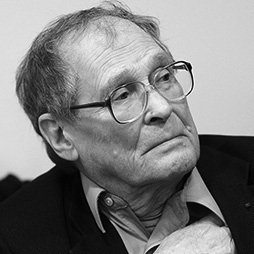
Sergei Adamovich Kovalev (March 2, 1930 – August 9, 2021), a Soviet political prisoner and human rights activist
“A free Russia, without repression or arbitrary use of law” was Kovalev’s dream, to which he dedicated his entire life.
In the 1990s, at the time of the First Chechen War, Russian journalists demanded to know why Kovalev only focused on the human rights violations of Chechens, not on those of Russian people. “This is simply untrue,” came his reply.
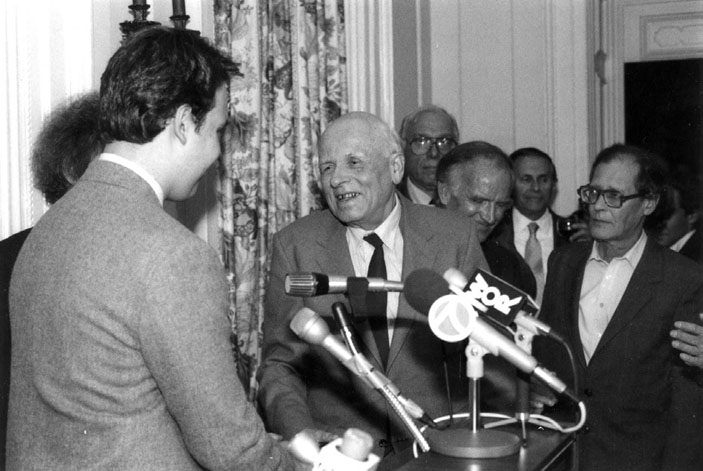
In 2005, he was asked a similar question: “Why do you so hate Russians and always speak in defense of those who hate Russians and fight against them? You keep defending Chechen bandits, Latvian fascists and Russophobes of all creeds.”
To that Kovalev responded: “I never defended specifically Uzbeks, or Latvians, or Russians. I always defended those who needed defense. I follow the Declaration of Human Rights, which is very clear on the subject: regardless of gender, age, language, religion, or race.”
Kovalev added: “You are mistaken to say that Russians were never an object of my human rights defense. We defended them – in the Baltics, and, indeed, in Budyonovsk. We fought for release of two thousand Russian hostages held at Budyonovsk hospital…”
Similar to Andrei Sakharov, Kovalev started out as a political activist in the 1960s, trying to force the Soviet authorities to adhere to the Soviet Constitution and other legal treaties, to which the Soviet Union was a signatory.
“This type of protest is far more ethically acceptable to me than undercover agitation and violence,” said Kovalev.
Since the 1960s, Kovalev was one of the editors of the Chronicle of Current Events that kept track of human rights violations in the USSR. Despite continuous blackmail and threats by the KGB, Kovalev felt it morally imperative to keep informing the world about human rights abuse in the Soviet Union.
Arrested in December 1974, Kovalev was tried in Vilnius a year later, charged with “anti-Soviet agitation.” On the very day in 1975 that the words of Sakharov’s Nobel lecture were galvanizing the audience in Oslo, Sakharov (who himself was banned from travelling to Oslo to accept his Nobel Peace Prize) was showing his support to Kovalev. He stood outside the courthouse in Vilnius where the Soviet authorities were doing their utmost to silence the unyielding Kovalev. So great was the fear of the brave man that Kovalev was even denied his last plea. Serving his sentence of seven years of hard labor and three years of exile, Kovalev returned to Moscow during Gorbachev’s Perestroika.
On Andrei Sakharov’s insistence, Kovalev ran and was elected deputy of the People’s Congress. Kovalev was one of the authors of the Russia’s human rights declaration and the first human rights’ ombudsman in Russia’s history. He served as Chair of the Human Rights Commission of the President’s office but following his sharp critique of Yeltsin’s “bloody and senseless” strategy in the Chechen war, he resigned from his post.
Already in early 2000, during the brief period of a caretaker government, Kovalev’s foresight led him to state that if Putin were to come to power, this would open a path to “an authoritarian, police state where the security services would be at the helm.”
In March 2010, Kovalev became one of the original 34 signatories of the public petition, “Putin must go,” alongside Elena Bonner, Boris Nemtsov, Garry Kasparov, Andrei Illarionov, Ilya Yashin and others.
In his interview in March 2020, Kovalev warned in the strongest terms of the dangers of criticizing Ukraine for its alleged fascist and banderovite tendencies. Kovalev did not live to see the descent of Russia into a senseless and bloody war, but he foresaw the risks with the utmost clarity. “Democracy is not the will of the people,” he said. “Democracy is freedom and right of minorities, including political minorities, to express their views and compete for the approval of the majority – without hindrance, honestly, openly. To compete with the political incumbents and other opponents.”
“Motherland is not a geographical term, nor is it an ideology,” stated the Yugoslav philosopher Mihajlo Mihajlov. “Motherland is freedom.” Ever a free spirit, Kovalev was an outstanding patriot of Russia, leaving his compatriots a priceless legacy.
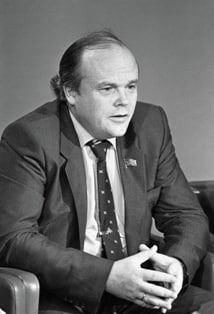
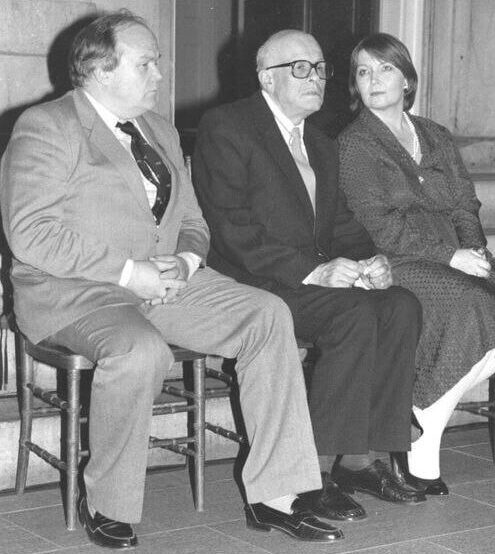
Evgeny Velikhov (February 2, 1935 – December 5, 2024)
Evgeny Velikhov, who passed away just two months shy of his 90th birthday, was a great scientist and a good man. A physics graduate of Moscow State University, he spent most of his career moving through the ranks of Kurchatov Institute of Atomic Energy. In 1988, Velikhov was appointed director of Kurchatov Institute. He also led ITER, the international program for the creation of the thermonuclear experimental TOKOMAK, a concept originally developed by Igor Tamm and Andrei Sakharov.
Velikhov’s early life was not suggestive of his future success in the Soviet hierarchy. Both of his grandfathers were arrested and shot in the 1930s during the Stalinist mass repressions. His mother died when he was a toddler and so he was mostly raised by his grandmother Vera, a Baltic German, who readily shared her hate of Vladimir Lenin and writer Maksim Gorky with her grandson. As for Joseph Stalin, she called him a criminal mass murderer. As a young boy, Velikhov spoke both Russian and German, reading brothers Grimm and later Goethe, in original.
In the 1980s, with Gorbachev in power, Velikhov focused considerable energies on achieving the nuclear tests bans and arranging for a regular inspections of the nuclear polygons by American and Soviet counterparts. Coming to the US, he worked with the ASF director Bob Kaiser, then a journalist at the WaPo, on a significant article on nuclear disarmament.
When Forum for the Survival of Mankind was due to meet in the USA, it was Velikhov who pushed for an approval for Sakharov’s travel abroad. Sakharov’s trip almost did not happen, and it was Velikhov whom Sakharov’s wife Elena called in the middle of the night: “Zhenya, we’ve got a problem.” Velikhov was able to solve this problem, as he solved numerous others for scores of different people, with his characteristic ingenuity and good humor. Back then, in November 1988, Velikhov was soon next to Sakharov in New York, assisted by ASF director Nina Bouis, who fondly remembers how Velikhov was the first person to explain her fractals.
The ASF expresses it deepest condolences to the family of Evgeny Velikhov.
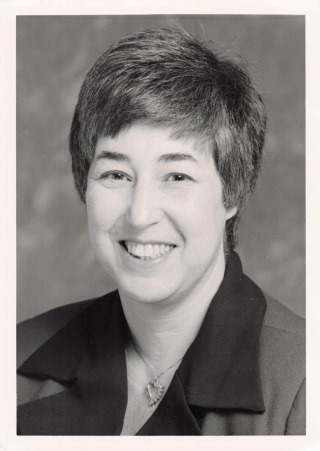
Felice Gaer (June 16, 1946 – November 9, 2024)
Felice Gaer Baran, an internationally renowned human rights expert who for more than four decades brought life and practical significance to the Universal Declaration of Human Rights and international commitments to prevent grave human rights abuses around the world, died on November 9, 2024 in New York City, following a lengthy battle with metastatic breast cancer. She was 78. At the time of her death, she was the director of the American Jewish Committee’s Jacob Blaustein Institute for the Advancement of Human Rights (JBI).
Longtime UN official and Acting High Commissioner for Human Rights from 2003-2004 Bertrand Ramcharan characterized Gaer as a “pillar of the human rights movement.” Former High Commissioner Zeid Ra’ad al-Hussein similarly deemed Gaer “a highly regarded champion of the universal human rights agenda.”
Throughout her career, in myriad roles, Gaer insisted that governments and the United Nations should consistently condemn the practices of tyrants and authoritarians and recognize that many forms of harm and inequality once considered ‘internal affairs’ of states as human rights abuses. Gaer’s influence established more protective interpretations of human rights norms from within and outside the United Nations human rights system. She effectively advocated for the creation and evolution of numerous international institutions and processes that play a critical role today in monitoring states’ human rights practices and holding violators to account.
Gaer achieved international recognition among human rights advocates as a force multiplier capable of overcoming the obstacles within government bureaucracies and multilateral institutions that often allow perpetrators of egregious abuses to avoid scrutiny and condemnation. Dr. Ahmed Shaheed, who served as the UN’s independent monitor on human rights in Iran and on the right to freedom of religion or belief, praised Gaer’s “exemplary track record” in 2021, stating that “You and JBI have made exemplary contributions to advancing human rights through the UN, especially in strengthening the effectiveness of the UN’s human rights mechanisms. Your own personal contribution, not just through the JBI, but in your own capacity as a member of the UN Committee against Torture and other roles, are not only legendary, but are a source of inspiration for everyone.” Elena Bonner, a one-time Soviet political prisoner, founder of the Moscow Helsinki Group, relentless advocate for democratic change in Russia, and wife of famed Soviet physicist, dissident, and Nobel Laureate Andrei Sakharov, with whom Gaer worked closely, recounted in 1997 that Gaer’s fierce approach to advocacy had helped a nascent international human rights movement find its voice. Said Bonner, “it was thanks to individuals like…Felice…who had the courage to be impertinent, that today it is more and more difficult for the rights-violating governments to challenge the universality of human rights and to ignore human rights concerns.”
Gaer began her career at the Ford Foundation as a program officer in 1974, focusing on the Soviet Union and Eastern Europe; subsequently, her areas also included arms control and human rights. At Ford, she became heavily involved in advocacy for the rights of Soviet Jewish refuseniks and encouraging broader internal changes that would catalyze greater respect for human rights for all in the Soviet Union. She maintained a passion for championing individual rights defenders while expanding her geographical focus. As the Executive Director of the International League for Human Rights from 1982 to 1991, Gaer championed human rights defenders throughout Latin America, particularly in Chile and Venezuela. She then served as Director of European Programs for the United Nations Association of the USA from 1992 to 1993, before becoming director at the Jacob Blaustein Institute in 1993 – where she remained for the following three decades.
Gaer served for nine terms as an appointed “public member” of official U.S. government delegations to United Nations meetings between 1993 and 1999, including six U.S. delegations to meetings of the U.N. Commission on Human Rights. As a public member of the U.S. delegation to the 1993 World Conference on Human Rights in Vienna, Gaer’s advocacy was instrumental in the creation of the position of UN High Commissioner for Human Rights. Gaer also played a critical role in bringing about the conceptual and political victory that the U.S. government achieved for women’s rights at the 1995 World Conference on Women in Beijing – at which the UN explicitly recognized for the first time that women’s rights are human rights – working closely with US Ambassador to the UN Commission on Human Rights Geraldine Ferraro and First Lady Hillary Clinton.
In 1999, Gaer became the first American and first woman to serve on the 10-person United Nations Committee against Torture, an expert body that monitors implementation of the Convention against Torture. She was first nominated as a candidate by the U.S. government during the Clinton administration and was renominated by Presidents George W. Bush and Obama. She was elected by UN member States to five four-year terms as an independent expert member and vice-chair of the Committee from 1999 to 2019, an unpaid position which she held concurrently with her other professional roles.
Over her 20 years on the United Nations Committee against Torture, Gaer insisted that the Committee and all other UN treaty bodies should affirmatively and publicly press governments to address allegations of wrongdoing, rather than accepting States’ assertions of compliance at face value. She led the Committee to develop practices that made it far more accessible to non-governmental organizations and human rights defenders seeking to share evidence of human rights violations. She also devoted extraordinary effort to ensuring that the Committee acted on information it received from third parties and conveyed accurate appreciation of the key human rights challenges occurring in every country it reviewed. Her rigorous and unsparing critiques – and her practice of inquiring about alleged victims of torture and arbitrarily imprisoned lawyers and advocates by name in public meetings – occasionally provoked angry outbursts by government officials accustomed to deferential, non-adversarial treatment in UN settings. However, Gaer’s approach turned what might otherwise have been pro-forma exercises into valuable opportunities for advocates to secure formal UN recognition of their claims.
Gaer’s efforts also led to a transformation in the Committee’s against Torture’s approach to the issue of violence against women, which previously was seen only as often a private matter rather than a form of torture or ill treatment for which perpetrators should be punished and victims of which are entitled to redress. The Committee became an important avenue for women’s rights advocates seeking to compel governments to develop more effective national capacities to protect women from violence, as well as members of vulnerable groups such as religious minorities and LGBTQI persons. These efforts brought significant public attention to previously overlooked issues in several countries. In one particularly noted case, Gaer’s insistence at public Committee meetings that Ireland had failed to address the abuses of the church-run ‘Magdalene Laundries’ – which had imprisoned and punished women the church had deemed ‘morally irresponsible’ – galvanized local advocates’ efforts for an official government inquiry to redress this longstanding historical injustice and acknowledge the State’s enduring obligations to survivors of the Laundries.
Gaer also championed the rights of religious minorities and victims of violence justified in the name of religion in countries around the world. Gaer was appointed and served five terms as an independent expert member of the bipartisan federal U.S. Commission on International Religious Freedom from 2001-2012, including as its chair. In that capacity, Gaer traveled to countries ranging from Sudan and Egypt to China to Afghanistan, directly pressing government officials to change policies and practices. She testified frequently before Congress and organizations including the Organization for Security and Cooperation in Europe on religious freedom issues.
Gaer’s commitment to universality also inspired her to work for decades to correct the persistent failure of the United Nations to recognize antisemitism as a serious human rights concern and to recognize the Holocaust as its most violent manifestation. Her engagement with public delegations to the UN Commission on Human Rights encouraged the U.S. to secure the inclusion of the first reference to antisemitism as an evil that UN efforts should seek to eradicate, in a resolution of the UN General Assembly, in a 1998 text condemning racism, using language previously negotiated by the U.S. at the Commission.
Thereafter, Gaer participated in the NGO conference that preceded the 2001 World Conference against Racism in Durban, South Africa, hopeful that it presented a moment of opportunity to secure recognition of Jews alongside other minorities facing racism and intolerance. When the conference devolved into a spectacle marked by overt displays of antisemitism and harassment and isolation of Jewish participants, leaving an indelible mark on Gaer and other Jewish participants and their allies, Gaer mobilized efforts among the ‘survivors’ of Durban to reflect on and memorialize lessons learned from the experience.
Gaer emerged from Durban with greater conviction of the responsibility of UN leaders to consistently demonstrate principled leadership and to reject discrimination and displays of identity-based hatred and remained determined to strengthen the international human rights framework for the benefit of all. UN Secretary-General Kofi Annan, who in 1998 became the first UN leader to acknowledge the Holocaust by name, was particularly receptive to these efforts. Together with Annan’s communications advisor, Gaer influenced the Secretary-General to affirm that the “Holocaust of the Jews” was “unique,” commemorate the centenary of Genocide Convention author Raphael Lemkin’s death in 2001, meet with an international delegation of Jewish leaders in 2005, and undertake new UN efforts to develop meaningful programs commemorating the Holocaust. Later, working with senior officials, Gaer supported US efforts to overcome the divisive legacy of Durban and negotiate a universally supported UN anti-racism agenda. She also collaborated with the advisers to successive UN Secretaries-General on Genocide Prevention, elaborating on the obligation to prevent genocide and developing UN policy guidance on combating Holocaust denial and genocide denial.
Gaer played a singularly important role in catalyzing UN attention to worrying trends of rising global antisemitism that began to be observed in many countries by 2017. At her direction, JBI provided support to and brought representatives of Jewish communities around the world to consultations with then-UN Special Rapporteur on Freedom of Religion or Belief Dr. Ahmed Shaheed, who then published the first stand-alone UN report on global antisemitism as a human rights concern in 2019 and an action plan on antisemitism in 2022. This was a truly ‘historic’ development that demonstrated to many skeptical Jewish community leaders and human rights advocates the enduring potential for United Nations mechanisms to encourage greater protection of the human rights of all. Said Irwin Cotler, acclaimed scholar and human rights advocate and former Canadian Special Envoy on Combating Antisemitism, “What you have done with respect to learning about and combating antisemitism…are sans pareille.”
Gaer not only shared her wisdom and practical experience with colleagues but also convened numerous strategy discussions and facilitated the work of hundreds of human rights defenders, advocates, and other independent UN experts through JBI grants that empowered and encouraged their efforts to advance human rights norms and protections on a wide range of subjects and countries. For many colleagues and beneficiaries of her support, Gaer was an invaluable resource, strategist, collaborator, mentor, and friend.
A prolific author of over 40 published articles and book chapters and editor of the volume “The United Nations High Commissioner for Human Rights: Conscience for the World,” Gaer received the American Society of International Law’s Honorary Member Award in 2023, an Honorary Doctorate from the Jewish Theological Seminary in 2018, and the First Freedom Center’s prestigious National First Freedom Award for her religious freedom advocacy in 2010. Gaer’s JBI was also named a “Champion of Prevention” by the UN Office on the Prevention of Genocide in 2023.
One of three children of Abraham Gaer, a businessman who owned a toy shop, and his wife Beatrice Etish Gaer, Felice was born on June 16, 1946 in Englewood, New Jersey. She was raised in Teaneck, New Jersey and graduated from Teaneck High School. She received a Bachelor of Arts degree from Wellesley College and pursued her graduate studies in political science at Columbia University’s Russian Institute (now Harriman Institute), where she received a Master of Arts degree in 1971 and a Master of Philosophy degree in Political Science in 1975. In 1975, she married Dr. Henryk Baran, a professor at the State University of New York-Albany; Dr. Baran has a long and distinguished career specializing in Russian literature and culture of the Russian Silver Age and avant garde. The couple’s two sons – Adam, a queer filmmaker and curator, and Hugh, a workers’ rights attorney who litigates wage theft, discrimination, and forced labor cases – survive her, as do her brother Arthur Gaer, sister Wendy Philipps, son-in-law Jacob Rozenberg, five nephews, and ten cousins. Gaer’s wisdom, support, conviction, and passionate concern for all humanity made her truly exceptional, and she will be deeply missed.
~ Christen Broecker, Deputy Director, Jacob Blaustein Institute for the Advancement of Human Rights
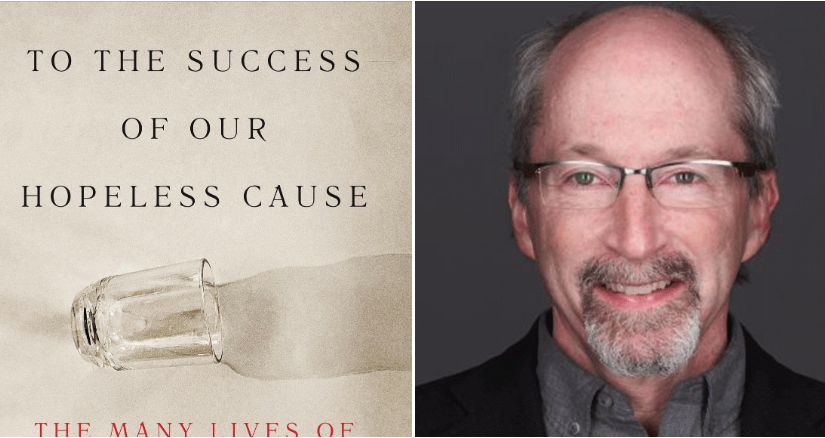
A new book “To the Success of Our Hopeless Cause” by Benjamin Nathans
See also:
Benjamin Nathans’ book talk and reading at Politics and Prose bookstore in Washington, D.C (YouTube)
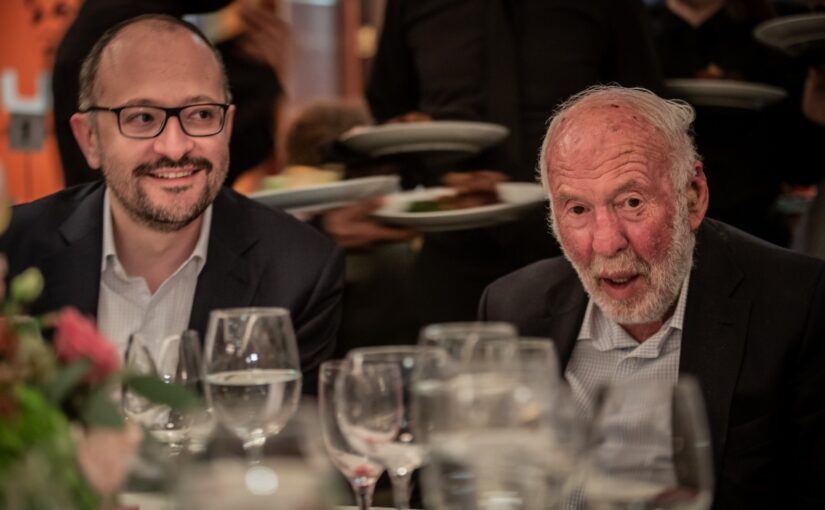
Photo: Alex Gerko and Jim Simons, at a gala in tribute of Andrei Sakharov, May 21, 2023. Carnegie Hall, New York
Jim Simons (April 25, 1938 – May 10, 2024)
The ASF was honored to host Jim and Marilyn at the concert and gala in tribute of Andrei Sakharov at Carnegie Hall on May 21, 2023.
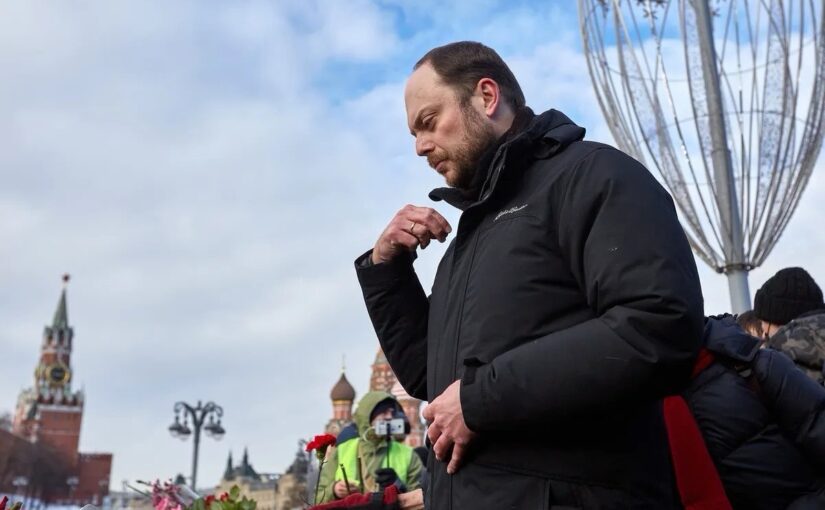
Congratulations to the courageous Vladimir Kara-Murza