
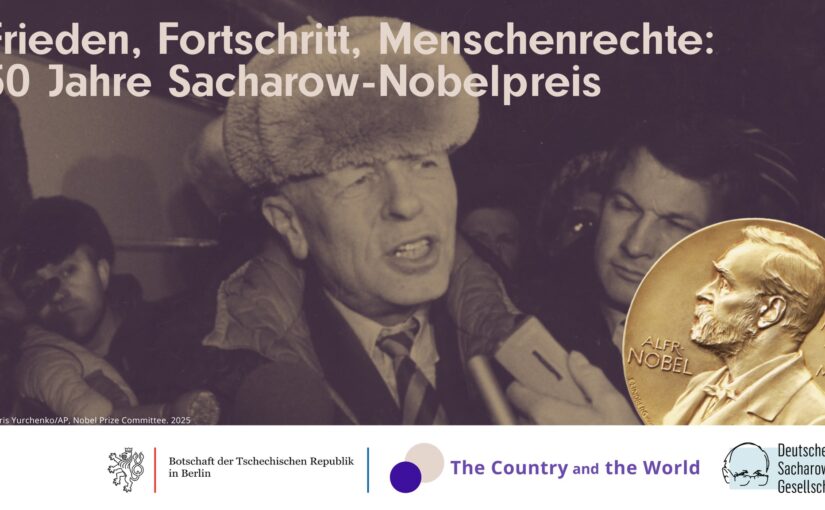
On 10th December 1975, the anniversary of Alfred Nobel’s death, a man who became known as the father of the H-bomb and a courageous human rights defender, failed to show up at the Oslo City Hall. Andrei Sakharov — the ‘conscience of humanity’, who was so styled by the Nobel committee and regularly referred as such by President Ronald Reagan,— was instead standing outside a court building in Vilnius, attempting to attend the trial of Sergey Kovalev. Thus, the day could have been counted as a double failure: earlier, the Soviet authorities refused to allow Andrei Sakharov to travel to Norway to accept his award; presently, they blocked his attempts to enter the court room.
Yet, Sakharov’s wife and comrade-in-arms Elena Bonner made it to the ceremony delivering Sakharov’s Nobel lecture, which led to a standing ovation and revolutionized the international politics.
Ever a visionary with ‘planetary thinking’ and deep empathy for the mankind, Sakharov shared insights so profound and left a legacy so impactful that it’s as relevant today as it has ever been.
The world finds itself in a precarious state as today. There is a full-blown war in the heart of Europe, casually thrown nuclear threats, and widespread doubts of countries’ commitments to international treaties — not least, within NATO where the trust in the US offering nuclear umbrella had been deeply dented. At the same time, most world leaders agree that there is a burning need to overcome all these challenges.
Sakharov insisted that human rights must be at the forefront of any negotiations — only adhering to international human rights allows achieving a just and lasting peace and maintain international security. May it be the time to re-visit Sakharov’s ideas in attempt to deal with today’s complex challenges?
A public discussion in Berlin, December, 10, taking place on the 50th anniversary of Sakharov’s Nobel Peace Prize, will address those questions. The discussion organised by the German Sakharov Society.
Location: Berlin-Brandenburg Academy of Sciences (Leibniz Hall), Jägerstraße 22/23, 10117 Berlin, from 18.00 to 22.00
The event will be held in Russian and German with translation.