
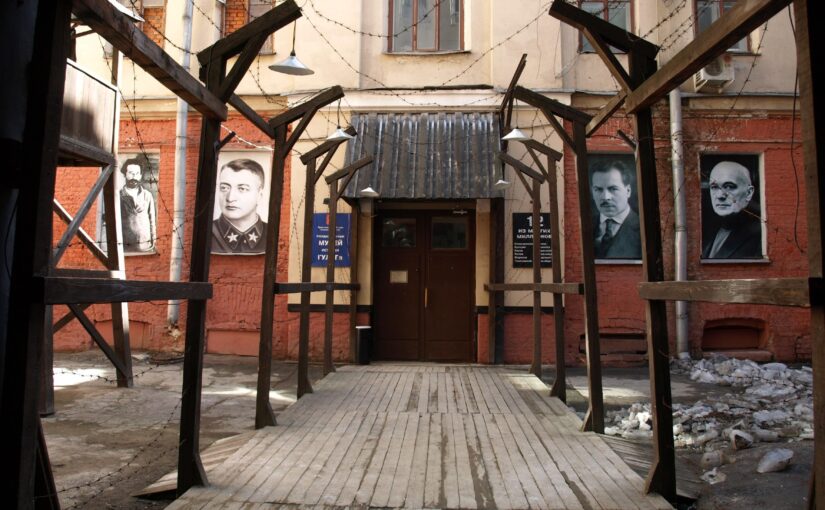
In 2024, Gulag History Museum was forced to close, with the authorities citing fire risks. The “fire safety” pretext was transparently false. High-ranking Kremlin officials and the FSB were behind the decision to close the museum; a Moscow government official told The Moscow Times that multiple inspections had not detected any fire safety violations.
The real trigger was an act of institutional resistance: Gulag History Museum director Roman Romanov refused to alter a section on Stalin-era repression in a new exhibition at the Museum of Moscow.
The collateral damage extended further: the director of the Pushkin Museum of Fine Arts, Elizaveta Likhacheva, was fired in January 2025 after publicly defending the Gulag Museum against its closure, illustrating a purge of non-aligned cultural cadres. The regime sent a clear signal that even expressing solidarity with the museum’s mission was professionally lethal.
The new institution will abandon the topic of Soviet state terror and instead be dedicated to the “genocide of the Soviet people” and Nazi war crimes. Visitors will learn about “manifestations of Nazism, biological weapons testing on Soviet citizens by the Japanese, the liberating mission of the Red Army, and trials of Nazi criminals.”
To lead it, authorities appointed Natalya Kalashnikova, a veteran of the war in Ukraine, holder of medals “To a Participant of the Special Military Operation” and “For Contribution to Strengthening Defence.” The appointment is itself a statement of intent — this is a wartime propaganda institution, not a historical one.
There is still no date of opening of the new museum, but Verstka, an independent investigative publication, reported on 13 April that the exhibitions of the Gulag Museum in Moscow were being packed up and moved away. The Gulag Museum collection is not destroyed, but now it’s unclear where it is.
This closure is not an isolated act — it is the culmination of a systematic dismantling of Gulag memory infrastructure:
In April 2025, Russia’s Supreme Court ruled that Memorial, a human rights movement founded to document Stalin-era crimes, is an extremist organisation and banned it — the culmination of a decade of unrelenting pressure since it was designated a “foreign agent” in 2016. In its decision, the court characterised Memorial as “anti-Russian,” devoted to destroying “historical, cultural, spiritual and moral values.”
Sergey Lukashevsky, the Sakharov Centre’s director, now based in Berlin, said: “The recent rebranding [of Museum of Gulag] sends a clear signal that the Russian authorities are prepared to do anything to remove the history of political repression from public view. The parallels with today’s situation in Russia are simply too obvious.”
The institution that preserved the memory of what trials during Stalin’s repressions represented — the Gulag museum founded by another former prisoner, Anton Antonov-Ovseyenko — has now been extinguished and replaced with its own inversion. The regime is not merely silencing the present: it is methodically erasing the past.