
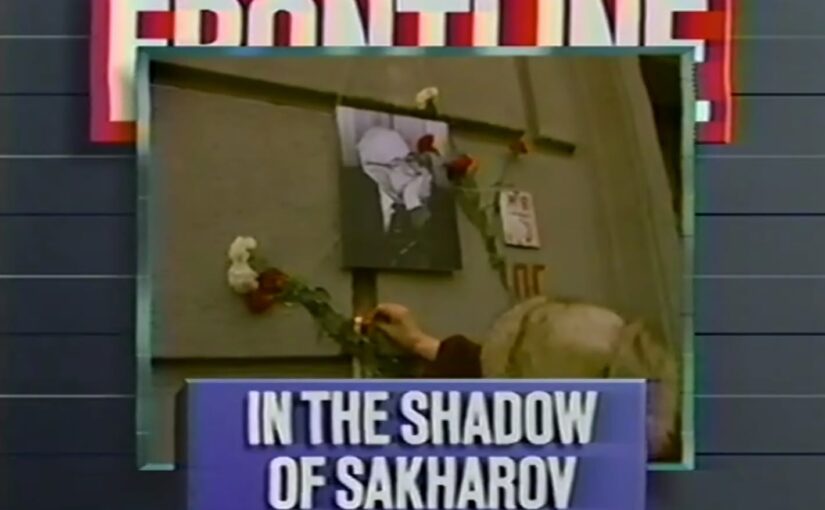
In the Shadow of Andrei Sakharov
A 1991 Documentary by Sherry Jones
“He had a duty to live longer” — so says one of the people interviewed in this film, produced by the American documentary-maker Sherry Jones, who spent time in Moscow between 1987 and 1991. From 1983 until 2009, Jones made over twenty films for Frontline on PBS, and her proximity to the Soviet Union in its final years gave her rare access to the people and institutions that shaped this portrait.
It may come as no surprise that a documentary shot so soon after Sakharov’s death in December 1989 conveys a deep sense of his presence. For Elena Bonner, his widow; Tatiana Sakharova, his daughter; and Ekaterina and Irina Sakharov, his cousins who grew up alongside him in his childhood home in central Moscow — the feelings were still raw, his absence still hard to bear. What is perhaps more revealing is how many people beyond his immediate circle realised, only after he was gone, just how profound their loss was. Watching the film today offers an unparalleled glimpse into Sakharov’s world through the eyes of family, friends and colleagues, set against archive footage obtained from the Soviet Ministry of Atomic Power (now Rosatom) and, remarkably, the KGB.
The film runs for an hour and a half and is packed with substance. Fellow physicists — among them Viktor Adamsky, who worked with Sakharov directly on nuclear weapons, and Evgeny Feinberg, a leading scientist from the Lebedev Institute in Moscow who visited Sakharov during his internal exile in Gorky — speak with authority about his science. A remarkable line-up of Soviet dissidents, including Vera Lashkova, Pavel Litvinov, and Alexander Lavut, alongside politicians such as Alexander Yakovlev, give their accounts of his activism and its significance.
One of the film’s most striking conclusions concerns Sakharov’s political foresight: he is described as “surprisingly realistic in his predictions for the future” — a judgement that lands with particular weight when viewed from today’s vantage point. Many of those interviewed speak of feeling orphaned by his death, and more than one voices the belief that had Sakharov lived longer, the democratic changes then transforming Russia might have taken deeper root — that his moral authority might have checked, or at least slowed, the reassertion of KGB and FSB power over political life that came to define the following decades. After all, throughout his life, Sakharov had shown, time and again, that a single voice of unimpeachable integrity could alter the course of events.
Seen with hindsight, the film is suffused with foreboding — a portrait of a society at a crossroads, grieving a man whose presence might have helped it choose differently.
https://www.dailymotion.com/video/x9oo30a